Why Bangladesh Fails to Stop Illegal Sand Mining Despite Repeated Crackdowns

- Update Time : Sunday, 26 October, 2025, 11:02 am
- 82 Time View
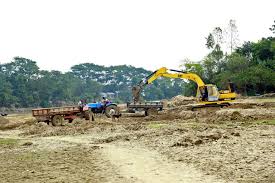
Illegal sand extraction has become one of Bangladesh’s most severe environmental crimes, with the trade expanding despite frequent government drives and public outcry. Along the Meghna River in Munshiganj Sadar upazila, politically backed groups—allegedly led by local BNP leaders—continue dredging sand well beyond their licensed areas, endangering nearby farmlands. Farmers say the relentless erosion is swallowing their fertile lands, yet the extraction persists.
Authorities conduct raids, impose fines, and make arrests, but the operators often receive advance warnings, allowing them to move their equipment before raids take place. This recurring pattern exposes a web of corruption, political protection, and administrative failure.
Similar incidents have been reported across Narsingdi, Moulvibazar, Sylhet, Chandpur, and Rangpur. In Raipura upazila of Narsingdi, illegal sand miners—allegedly part of an armed group linked to influential political figures—have violently resisted law enforcement, even attacking mobile court teams. In Moulvibazar, despite over 50 raids and confiscation of sand worth Tk 17 crore, the extraction continues unchecked, destroying roads, riverbanks, and aquatic habitats.
The environmental toll is alarming. Rampant dredging accelerates riverbank erosion, destroys fish breeding grounds, and disrupts waterway stability. In Charmsura, Munshiganj, vast tracts of farmland have vanished under the river, devastating local livelihoods and food production. The unregulated dredging also violates ministry bans on sand extraction during the Hilsa spawning season.
Officials often cite inadequate manpower and limited budgets as barriers to enforcement, but these explanations no longer suffice. The root cause lies in the absence of political will and accountability. Authorities must revoke leases of violators, punish negligent officers, and dismantle the networks shielding illegal operators. Coordinated action among the land, fisheries, and environment ministries is crucial to restoring integrity to the system.
Only through strong political resolve, transparent enforcement, and ecological responsibility can Bangladesh hope to curb this destructive trade and protect its rivers from irreversible damage.