Signing Without Consensus: Will the July Charter Deepen Division?

- Update Time : Friday, 17 October, 2025, 05:39 pm
- 78 Time View
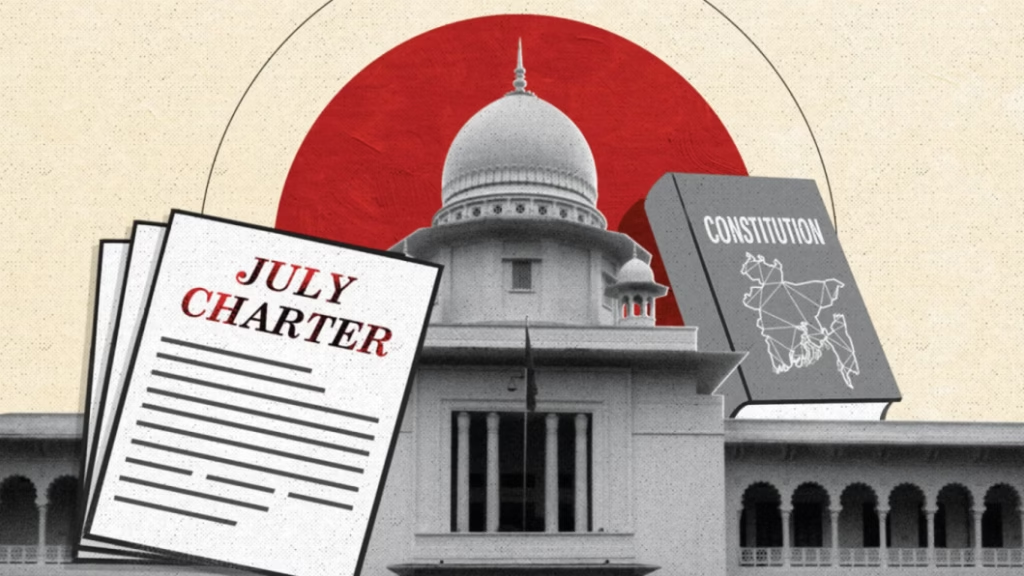
The interim government is set to organize the signing of the July Charter on October 17, having already distributed the document to all political parties three days earlier. However, the developments of the past three weeks reveal that the effort to reach clarity on how to implement the Charter has failed. Instead of resolving confusion, the process has made the path toward constitutional reform even murkier.
The Commission has declared that the signatories will execute the reforms outlined in the Charter but has avoided explaining the mechanism for doing so. The central challenge lies in the fact that, out of the 84 proposals included in the Charter, full consensus has been reached on only 28.
Among these 28, several are highly significant reforms — such as limiting the prime minister’s tenure, allowing the opposition to chair parliamentary committees, separating the judiciary from the executive, appointing a neutral election commissioner, and establishing an independent police commission. Even though there are differing opinions regarding Article 70, implementing these agreed-upon items would still mark major progress toward a more functional parliament.
Yet, even these 28 proposals face hurdles. Though all parties agreed they should be subject to a referendum, there is no consensus on how to hold that referendum. Consequently, implementation remains stalled until agreement is reached on the procedure.
The more contentious proposals deepen the divide. Seven proposals have been opposed outright by over five parties. For instance, the idea of removing the March 7 Speech from the Constitution faced rejection from nine parties, while seven parties objected to the creation of three separate commissions.
The BNP has opposed fifteen proposals, nine of which are also rejected by the NDM, the 12-Party Alliance, and the Nationalist Like-Minded Alliance. Four parties — Islami Oikya Jote, NCP, Gono Sanghati, and Bangladesh State Reform Movement — have not raised any objections. The groups with the highest number of objections are BASAD (16), BNP (15), and the 12-Party Alliance (13).
Further complications arise from “notes of dissent” on sensitive issues — including the powers of the President, the structure of a caretaker government, the allocation of seats in the Upper House, and the appointment of constitutional officers such as the Ombudsman and Auditor General. On almost every issue where the BNP has expressed dissent, the NDM and its allied blocs have followed suit.
If any of these disputed proposals are implemented without consensus, the political situation could deteriorate, casting doubt over the next election and risking national instability. Many analysts warn that prolonged uncertainty could push the country into deeper turmoil.
By leaving implementation plans undefined, the July Charter risks destabilizing the reform process. The interim government and the Consensus Commission must realize that rushing constitutional changes could have grave long-term consequences. Building consensus — even if it takes time — is essential.
To manage the current situation, holding a referendum on the agreed-upon proposals could be an immediate step forward. Within the Commission, there was broad support for holding the referendum alongside the national election. Only those proposals that have full consensus should be included in this process.
For issues still under dispute, a long-term Constitutional Reform Assembly could be established. This body might include representatives from various social and professional groups, similar to the 1937 Legislative Assembly model, ensuring that diverse voices are heard. Members could include newly elected legislators, participants in the Consensus Commission, women, civil society representatives, professionals, religious minorities, and non-Bengali groups. The Commissioners could serve as advisors to this assembly.
Freed from strict deadlines, this assembly could deliberate over the contentious proposals until genuine agreement is achieved. Lessons can be drawn from Indonesia’s constitutional reform, which unfolded gradually between 1999 and 2002. Indonesia’s approach — negotiating patiently even on divisive issues like Sharia law and provincial autonomy — ultimately strengthened its national unity.
Bangladesh, too, must embrace its internal diversity. Sustained dialogue between opposing sides is the only path toward a shared vision. With patience and inclusion, consensus will eventually emerge.
The interim government has shown restraint in fulfilling earlier commitments to maintain quality and credibility. If it applies the same prudence to constitutional reform, prioritizing careful planning over haste, it can safeguard the people’s interests. The signing of the July Charter should only proceed once a clear, collective roadmap for implementation is in place.